01
Heritage Briefing #1
01 February 2021
The Social Media Edition
 Heritage Briefing #1

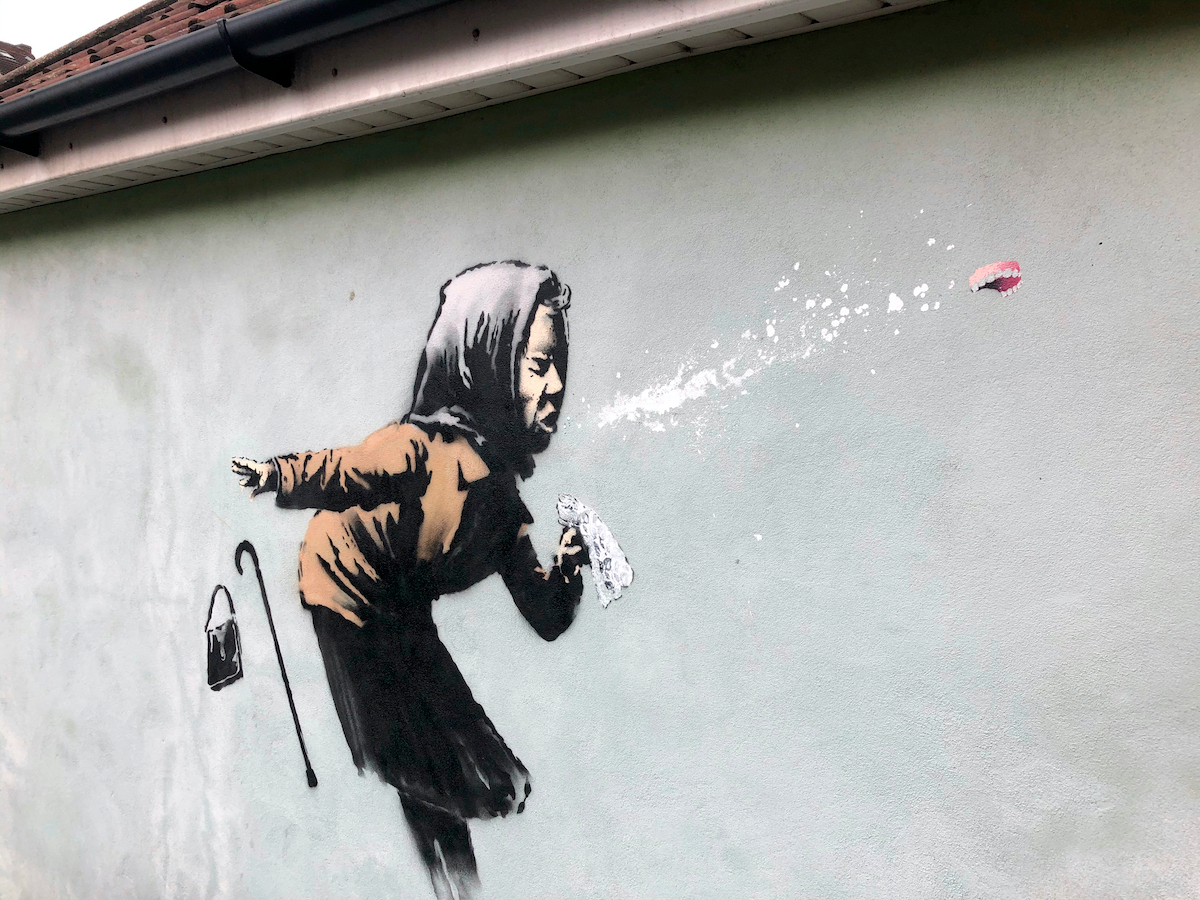
We interviewed Roo Foley, one half of the dynamic conservation duo that makes up Foley Schalkx Conservation. Based in London, Foley Schalkx are specialist conservators of art, known in particular for their preservation of Banksy artwork.
An elderly woman sneezes out her dentures in Banksy’s new COVID-themed work
We’ve been going as a studio for four years and we never set out to work with so many Banksys – it just happened that way – but we handle so many now, that when I recently asked a client how big his Donald Judd print was, he said, ’70×100′, and I immediately thought: ‘Ah, Flying Copper size!’ I just think in Banksy sizes now…it made me chuckle.
I met my business partner, Maartje, at Camberwell College of Arts and we worked together at John Jones. I’ve known her for eleven years now. We’d see a lot of Warhols in our early days, a lot of Patrick Herons, Hockneys, that sort of thing, but only the occasional Banksy. Then the market for Banksys just went crazy, but it’s been especially busy this year.
It seems to be quite a male-dominated market… Many bought a Banksy in the early ’00s and still have it, but also, from what we can see, they seem to change hands quite frequently. We often have a client come in with a Banksy that has been stored rolled under the bed for 15 years, or hanging in a less than ideal location, in a less than ideal frame.
They bought it for £50, put it in an Ikea frame and now they’re worried about it and they need to get it insured and know what condition it’s in. Especially this year, we’ve seen more and more of those kinds of clients.
I think people have been at home with the time to finally do something about this object that they know is valuable. People tend not to know much about conservation, and time at home has allowed them to deal with a job they’ve been putting off and to get the ball rolling. People often think conservation will be costly and take a long time, and of course, sometimes it is and does, but often quite minor treatments are extremely beneficial.
Conservation doesn’t always give an immediate, obvious return, in contrast to framing for example, so perhaps people have had a chance to learn a little more and take the necessary steps to look after their artwork.
People often bring us an artwork at the point of sale, they want to know if it has any issues, but regardless of whether they’re buying or selling, we don’t get involved with how conservation might affect the value of something. There’s also been a lot of online shopping this year and there’s more art changing hands at the moment. There’s been a huge increase in the value of Banksy prints and that may be pushing the market.

Ninety percent of what we’re treating is related to poor framing, poor handling, and poor storage. Poor framing is the cause of the vast majority of the damage we see, and in particular, the use of inappropriate tapes and adhesives are a big problem too. And there’s accidental damage of course. Materials that aren’t acid-free is another big one. If you have a backboard that isn’t acid-free, those acids migrate into the paper and set up discolouration and deterioration of the paper fibres.
We also often see works that have been window mounted. Two possible problems arise here: again, an acidic mount will discolour and start deterioration of the print, and fading can occur in the central area; that’s a really common problem. These prints often have a stark colour differential, even though they aren’t that old.
Another common problem is prints being stored rolled and needing to be flattened. Creases and crush marks are really common. Sometimes we do relatively little in the way of intervention, often the treatment is quite minor, but it’s interesting, often the newer something is, the greater the expectation that it will be in perfect condition.
We have, yes… We’ve had all sorts!
There’s always a lot of problem-solving involved in conservation and the most rewarding jobs have been where we’ve had to develop a technique to deal with a specific problem.
In particular, we had an etching on Japanese paper. It was in bits, discoloured, ever so creased and very fragile, thin like tissue paper. I remember opening the box, and thinking, ‘Gosh!’, and wishing I’d not opened it! We didn’t know where to start, but without treatment, it wouldn’t have been possible to handle, view or frame the artwork, and if we hadn’t done something there would have been no way of appreciating its existence.
So, we float-washed it, supported on Japanese paper. We did this gently a few times, and the appearance of the print was improving, the discolouration reducing, and while we washed we pondered how to support and display the work, and how best to make repairs. Should we line it? All sorts of questions.
As we progressed we realised that the best way to treat the object for display and storage would be to allow paper fibres on the verso of the etching to mesh with those of the support paper, and it dawned on us that this in itself could be a method of mounting an artwork without using any adhesives or additional materials.
Japanese paper has a smooth side and a fluffy side, so we utilised that characteristic. It meant we didn’t need to do any infills or tear repairs, and the result was particularly satisfying.
Yes, here are my top five:
1. Get to know your artworks. Have a really good look at them. Photograph them so that you can spot future changes. When you live with something, day-in, day-out, you don’t notice the gradual changes that can occur, so documentation is vital.
2. Framing. Pay the money to have a professional frame your artwork, someone who knows their materials. You have to use acid-free materials and if possible, Japanese-paper hinges and rice-starch adhesive. If the framer can’t guarantee this standard or is unfamiliar with the materials, go elsewhere.
3. A lot of people are misled by UV protective glazing and think that because they have the highest-quality glazing, their artwork is immune from light damage. Not so. All light is energetic, and the damage is cumulative, so if you do have something that is particularly prone to light damage, watercolours or works in felt-tip, for example, rotate them and keep them out of direct sunlight.
4. Be aware of where you place your artwork. Don’t put things over a radiator, in a damp corner, near candles, over the bath, under intense spotlights and so on. All these things can be detrimental to a print.
5. If you’re ever transporting artwork, it’s worth spending some money and engaging a designated art shipper. People often bind things up and use an awful lot of tape, and it just isn’t necessary and often creates more risk to the object and more problems than it solves. The last thing we want to have to do is slice away a load of unnecessary packaging with a scalpel…
You’re very welcome!
The Social Media Edition
Heritage Briefing #1
How to future-proof a stately home written by Marc Allen
 How to Future-Proof a Stately Home
The Heritage Creative site is now live!
 Heritage Creative is born!
I was delighted to attend yet another AIM conference this year, and just like last year, it was fantastic.
 AIM Summer Conference 2019